Association says Rs500 million capital requirement and a network of 15 workshops would have excluded smaller traders
By Irfan Siddiqui
The All Pakistan Car Dealers & Importers Association (APDA) has called for an independent, transparent and time-bound inquiry into the introduction and enforcement of disputed conditions governing the commercial import of used vehicles.
In a media brief issued on October 16, 2026, the association alleged that additional regulatory requirements undermined the federal government’s decision to open Pakistan’s automobile market to competition and threatened to exclude small and medium-sized importers.
APDA sought an investigation into the conduct of Secretary Industries and Production Saif Anjum and relevant Engineering Development Board (EDB) officials involved in drafting, approving and implementing the conditions. It stressed that allegations of improper influence, collusion or personal benefit must be examined through evidence and due process.
The association said its central objective had been to secure permission for commercial imports of used vehicles and give Pakistani consumers greater access to affordable, reliable, safe and technologically advanced cars.
According to the brief, the government agreed in May 2025, under its International Monetary Fund programme commitments, to liberalise commercial imports of used vehicles.
The Economic Coordination Committee approved the removal of quantitative restrictions on September 24, 2025, followed by federal cabinet ratification on September 26. The Ministry of Commerce subsequently issued SRO 1895(I)/2025 on September 30, permitting commercial imports subject to prescribed conditions.
APDA described the decision as a significant opportunity to expand consumer choice, encourage competition and create business opportunities for Pakistani entrepreneurs.
However, the association alleged that certain influential local assemblers, acting through some officials in the Ministry of Industries and Production and EDB, sought to obstruct implementation by introducing excessive non-tariff barriers.
The disputed conditions included restricting imports to companies incorporated under the Companies Act, 2017, minimum capital requirements, extensive after-sales service arrangements, spare-parts availability and restrictions on the recognition of inspection agencies.
The brief also criticised mandatory post-shipment inspection in addition to pre-shipment inspection, arguing that the duplication increased costs and administrative burdens.
According to APDA, EDB subsequently published registration criteria requiring importers to maintain Rs500 million in paid-up capital and a network of 15 workshops.
The association said these requirements would have effectively excluded individual dealers and most small and medium-sized businesses, leaving only a limited number of financially powerful corporations able to participate.
APDA said the published registration criteria were withdrawn following its sustained objections and intervention.
The association cited a Federal Board of Revenue office memorandum dated March 10, 2026, as supporting its concerns. According to the brief, FBR questioned the conditions relating to company incorporation, capital requirements and after-sales service networks, observing that they appeared not to have received federal cabinet approval.
The brief said FBR also questioned the duplication of pre-shipment and post-shipment inspections and identified an apparent inconsistency between EDB’s restrictions on inspection agencies and the Ministry of Commerce’s SRO 2443(I)/2025.
APDA further referred to a Ministry of Science and Technology letter dated April 15, 2026, concerning the respective mandates of EDB and the Pakistan Standards and Quality Control Authority (PSQCA).
According to the association’s account, the ministry identified PSQCA as Pakistan’s sole national standards body and referred to its statutory responsibilities for national standards, including those relating to automobiles.
The brief said the ministry also raised concerns that the proposed Motor Vehicles Industry Development Act would duplicate regulatory functions and encroach upon PSQCA’s jurisdiction. It consequently withdrew its earlier no-objection to the draft legislation.
APDA acknowledged that the ECC had authorised EDB and the Ministry of Industries and Production to prescribe requirements for the import framework. It said its objection concerned the extent of those powers and the introduction of conditions beyond the approved policy.
The association also highlighted the Ministry of Commerce’s issuance of SRO 2443(I)/2025 on December 16, 2025, recognising pre-shipment inspection agencies registered with PSQCA and meeting prescribed international accreditation requirements.
It said subsequent clarifications addressed the acceptance of inspection certificates and the applicability of EDB’s commercial import conditions.
Calling for accountability, APDA said an inquiry should establish the legal basis for the additional requirements, identify who authorised the Rs500 million capital and 15-workshop criteria, and determine why those criteria were subsequently withdrawn.
It also sought an examination of whether commercial interests improperly influenced policymaking, whether the conditions were intended to exclude smaller businesses, and whether any public official acted under a conflict of interest or obstructed implementation of the cabinet’s decision.
The association requested scrutiny of relevant notifications, correspondence, registration criteria, meeting records and approval files.
The brief also challenged arguments that used-vehicle imports necessarily harm Pakistan’s economy. APDA said it supported genuine domestic manufacturing, employment creation and technology transfer, while arguing that prolonged protection should be assessed against its results for consumers.
It questioned the progress made by local assemblers on localisation, competitive pricing, technology transfer and vehicle safety despite decades of government protection and incentives.
According to APDA’s estimates, Pakistan has more than 10,000 automobile showrooms supporting approximately 300,000 to 350,000 direct jobs, alongside employment in workshops, spare parts, transport, inspection and logistics.
The association also estimated that combined duties and taxes on commercial vehicle imports could reach 569 per cent in certain categories. These figures were presented as APDA’s estimates, rather than independently verified official findings.
APDA called for locally assembled and imported vehicles to meet the same internationally recognised safety, environmental and quality requirements, including relevant UNECE WP.29 standards.
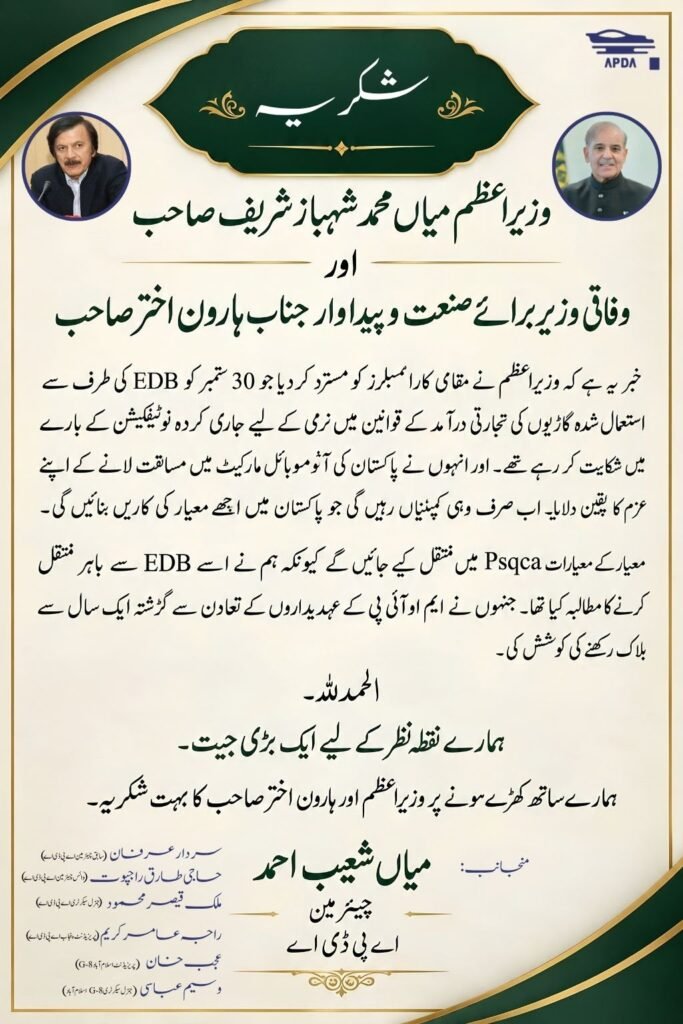
The association thanked Prime Minister Shehbaz Sharif, the Chief of Army Staff, Special Assistant to the Prime Minister on Industries and Production Haroon Akhtar Khan, Senator Faisal Vawda and other government and parliamentary representatives for supporting reforms and efforts to resolve importers’ concerns.
It maintained that Pakistan’s automobile policy should promote fair competition, meaningful local manufacturing and access to safe, affordable vehicles.
The supplied media brief did not include responses from the Ministry of Industries and Production, EDB, Saif Anjum or local automobile assemblers to the allegations.
Page 3 full page